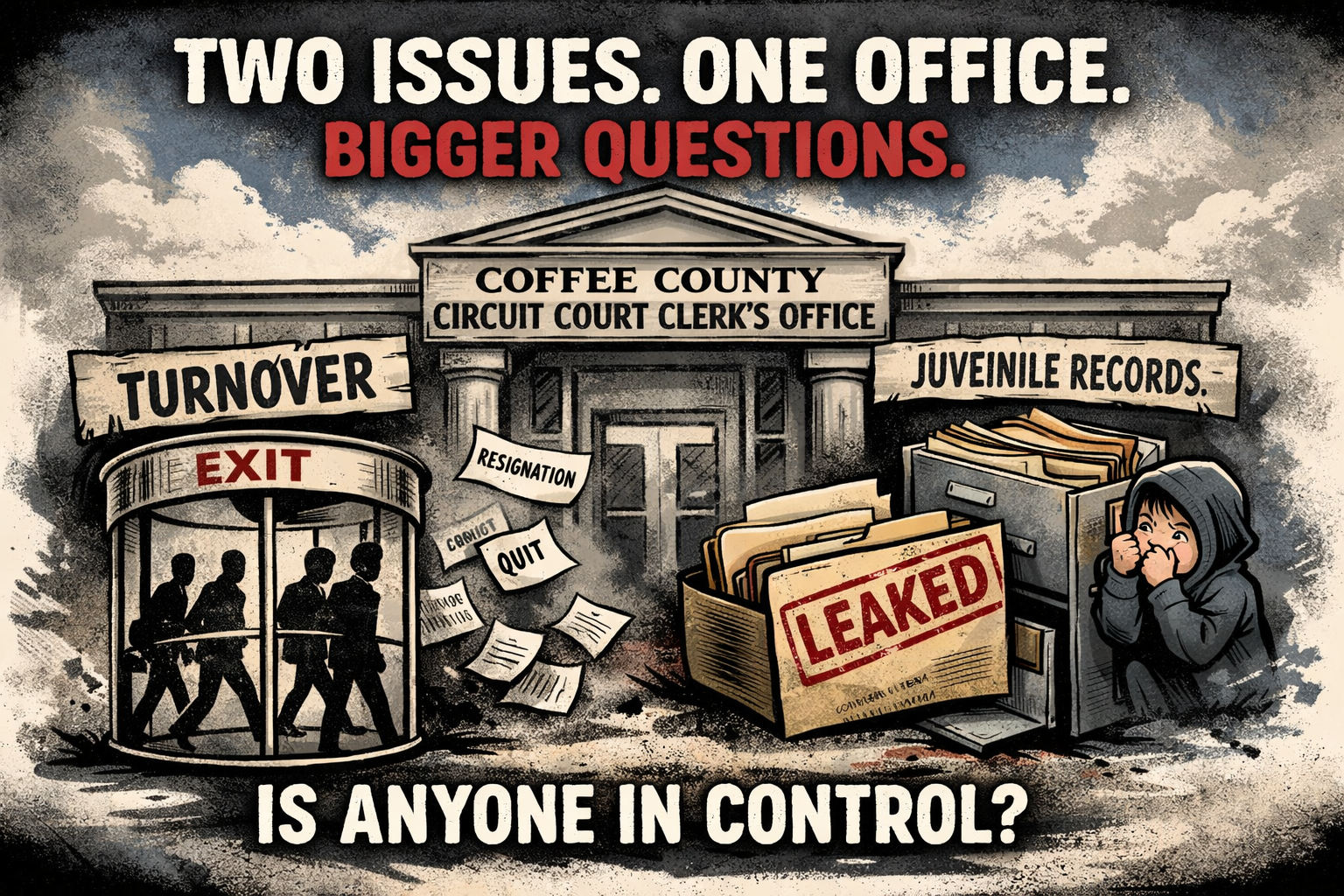

If Coffee County’s Circuit Court Clerk’s office has seen 23 of 25 full-time positions vacated since 2021, the public is looking at something far bigger than ordinary staffing churn. That level of turnover in a court office is a warning sign, and pretending otherwise insults the people who rely on that office to function.
This matters because the clerk’s office is not some optional corner of county government. It handles filings, records, and court administration that affect residents, attorneys, law enforcement, and the basic movement of cases through the system. An office like that depends on continuity, accuracy, and people who know what they are doing. When the staff keeps turning over, the public has every right to ask what is going on.
When a court office loses nearly its entire staff, the public does not need a shrug. It needs an explanation.
A 92% turnover figure is not something officials should breeze past
The figure cited in the brief is stark: 23 of 25 full-time positions vacated since 2021, or about 92% turnover. Even with the usual caveats about how turnover is counted over time, that is still an extraordinary amount of churn for a public office with court-facing responsibilities.
Reported turnover since 2021: 23 of 25 full-time positions vacated
Reported rate: approximately 92%
The source material indicates repeated departures across multiple years
The packet suggests both short-tenure exits and the loss of longer-term staff
That kind of instability does not automatically prove a single cause. It does prove there is a serious public-interest question that deserves a straight answer. What residents should not accept is silence, vagueness, or the usual dodge that staffing is hard everywhere. Staffing may be hard everywhere. Near-total turnover in a critical office is not everywhere.
The real issue is continuity in a job that depends on experience
Court offices run on institutional knowledge. People learn the workflow, the deadlines, the records systems, the internal coordination, and the practical habits that keep mistakes from piling up. When experienced workers leave, that knowledge leaves with them. Then the office has to start over again, train again, and hope the next round stays long enough to get fully up to speed.
That is why turnover in an office like this is not just an HR problem. It creates a real risk of slower service, inconsistency, and avoidable disruption. The packet provided here does not include hard service metrics like backlog numbers or error rates, so those impacts should not be overstated. But the public does not need a spreadsheet to understand the basic point: constant replacement is a bad way to run a court office.
Taxpayers are likely paying for this churn more than once
There is also the money side. Every departure means another round of recruiting, onboarding, training, supervision, and lost productivity. In a stable office, those costs are occasional. In an office with repeated turnover, they become recurring.
The brief cites a general turnover-cost estimate of roughly 33% of total compensation. Using the example provided, a $55,000 salary with overhead produces about $68,750 in total compensation, and an estimated turnover cost of roughly $22,688 per departure. That is a model, not a county accounting ledger, and it should be treated that way. Still, the larger point is hard to escape: repeated turnover is not free, and taxpayers are likely absorbing the cost of constant reset.
What the public should be asking now
Jenny Anthony is the elected Circuit Court Clerk. County government funds the office. That means this is not just a private workplace issue buried in an HR file. It is a public accountability issue, and the questions are basic.
What is driving this level of turnover
What service areas have been affected, if any
How much repeated hiring and retraining has cost
What steps are being taken to stabilize the office
Why the public has not been given a fuller explanation already
Those questions are not unfair. They are overdue. A public office that handles critical court functions should not have to lose nearly its entire staff before anybody feels pressure to explain the pattern.
Coffee County does not need spin here. It needs answers.
With the current packet, no one can honestly claim to have fully proved the internal cause of every departure. But that limitation cuts in one direction: it means officials should be pressed harder, not less. Because the known facts are already serious enough. Near-total turnover in a court office is a flashing warning light, and the burden is on leadership to explain why this happened and what will stop it from continuing.
Until that explanation is public, residents are left with the obvious conclusion that something is badly off in an office that should be steady, competent, and reliable. And for a court office, that is not a small problem. That is the problem.